
How to Choose a Luxury Metal Fountain Pen in India: A Buyer’s Guide from the Delhi Pen Trade
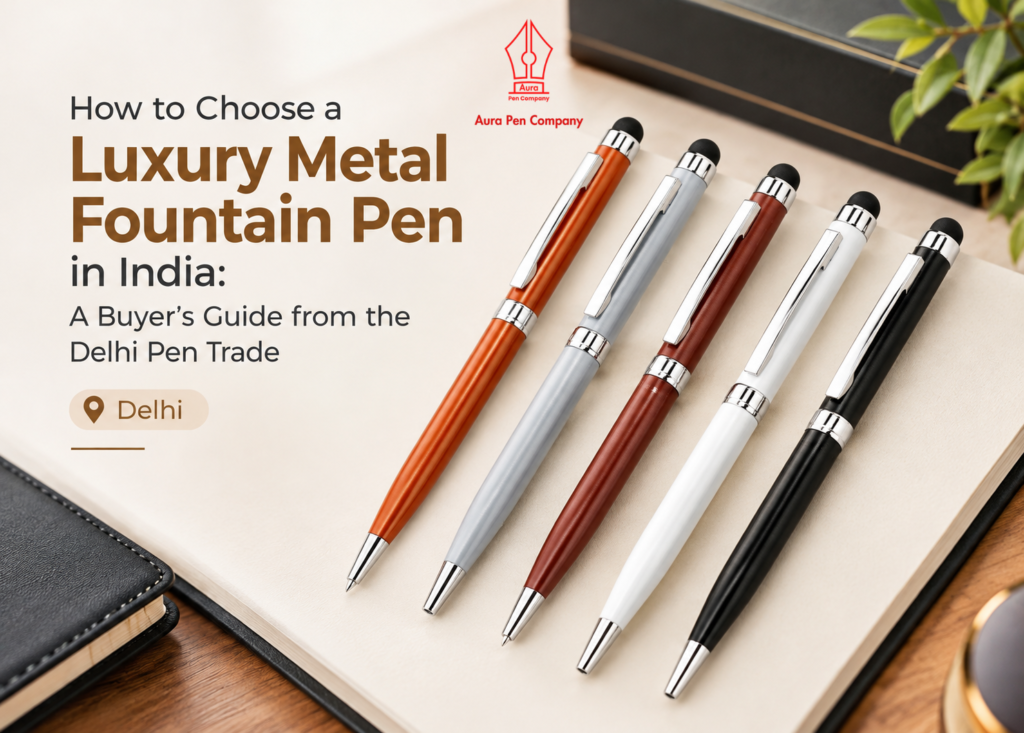
Spend enough years around the pen markets of Delhi and you start to notice something. People rarely walk in saying, “I want a nib with good feed flow and a brass barrel.” They pick up a pen, hold it for a few seconds, and say, “this one feels right.”
That first feeling matters a lot, but it can also fool you. I have seen a heavy, shiny pen disappoint within a month, and a plain-looking one last ten years.
So this guide is what I would tell a friend who asks me over chai. If you are shopping for a luxury metal fountain pen in India, here is how to look past the shine and find one worth keeping.
What Makes a Fountain Pen “Luxury” in the First Place?
The word gets thrown around a lot. A high price tag does not make a pen luxurious, and neither does a gold-coloured clip.
In my experience, a luxury metal fountain pen earns the label through four things:
-
- A nib that writes well straight out of the box. No scratching, skipping or hard starts.
-
- Balance and weight that suit your hand. A good pen should disappear while you write.
-
- A finish that survives real life. Keys, pockets, desk drawers and sweaty Delhi summers.
-
- Honest construction. Clean threads, a firm cap click and a clip that does not wobble.
If a pen gets these four right, it feels premium. If it misses even one, the packaging cannot save it.
Body Material: Brass vs Stainless Steel
Most metal fountain pens you will find in India use one of these two metals. Here is how they differ.
Brass is the traditional favourite. It is dense, warm to hold and takes plating or lacquer beautifully. A brass pen has a reassuring weight, though it can tire your hand during long writing sessions. It also needs good plating, because a thin coating wears off at the grip and edges.
Stainless steel is lighter and tougher. It resists dents and corrosion well, which matters in humid cities, and it suits people who write for long stretches. The trade-off is that it can feel a little cooler and less “classic” in the hand.
Neither is better. It depends on how you write. Short signatures and desk use suit brass, while all-day note-taking is easier with stainless steel.
The Nib: Where the Real Quality Hides
If the body is the face of a pen, the nib is its heart. This is the part most first-time buyers skip, and it is the part that decides whether you will enjoy the pen.
Nib size. You will usually see EF (extra fine), F (fine), M (medium) and B (broad). Indian paper is often thinner and more absorbent than imported notebook paper, so a fine or medium nib is the safest starting point. Broad nibs look lovely but can bleed on cheaper paper.
Nib material. Steel nibs are the norm in this segment and they are perfectly good when finished well. Look for a smooth, rounded tip. Run it across a sheet and listen. A good nib makes a soft sound. A bad one scratches.
Feed. This is the plastic or ebonite piece under the nib that carries ink. If the pen skips after a few lines, the feed is usually the culprit, not the nib.
A tip from the trade: always write a full paragraph before buying, not just your name. Your signature is short and forgiving. A paragraph shows you everything.
Cartridge, Converter or Piston?
How the pen holds ink changes your daily experience, so think about this before you pay.
-
- Cartridges are clean and simple. Pop one in and write. They are ideal for gifting and for beginners.
-
- Converters let you fill from a bottle, so you can use a wider range of inks. Check that the pen ships with one, or that a standard size fits.
-
- Piston fillers hold more ink but are rare in this price range.
For most buyers in India, a pen that accepts both cartridges and a converter is the sweet spot. You can start easy and experiment later.
Finish and Plating: The Part People Forget
Metal pens are judged first by their finish and last by their finish. It is the first thing you admire and the first thing that fails.
Matte, chrome, gold-tone and black finishes each age differently. Matte hides fingerprints but can show shiny wear spots at the grip. Chrome stays bright but shows scratches. Always check the cap threads and clip edges, because that is where cheap plating gives up first.
When I evaluate a pen, I rub my thumb along the section and the cap rim. If it feels sharp, uneven or gritty, I put it down.
Why Buying in Delhi Gives You an Edge
Delhi’s pen trade is old and deep. Areas like Jhandewalan, Sidipura and Karol Bagh have handled metal pens, gift sets and stationery for decades. Fountain pen bodies, finishing work and packaging are all within reach of each other.
For a buyer, that means two practical benefits. First, you can often handle the pen before ordering, which is the best quality check there is. Second, shorter supply chains usually mean better pricing and quicker delivery than buying through layers of resellers.
At Aura Pen Company, our showrooms in Jhandewalan and Karol Bagh let buyers hold, test and compare before they commit. I would encourage you to do the same with any supplier, wherever you are.
Who Is a Luxury Metal Fountain Pen For?
Not everyone needs one, and I would rather say that honestly.
A fountain pen suits you if you enjoy writing, sign documents often, or want a gift that people actually use. It is a poor fit if you write on carbon copies, scribble in a hurry on rough paper, or hate maintenance.
If you are buying for others, such as clients, staff or family, we have a separate guide on why fountain pens make premium corporate gifts. It covers the gifting side in more detail.
Simple Care Tips That Double a Pen’s Life
A good pen needs very little, but what it needs, it needs regularly.
-
- Flush the pen with clean water every four to six weeks if you use bottled ink.
-
- Do not leave it uncapped. Ink dries in the nib and causes hard starts.
-
- Store it flat or nib-up if it is partly empty.
-
- Use ink made for fountain pens. Avoid waterproof or India ink unless the pen is built for it.
-
- Wipe the body with a soft cloth. Skip harsh cleaners that eat into plating.
For protection while travelling, a proper case helps. Our guide to a leather pen case in India explains what to look for.
A Quick Checklist Before You Buy
Keep this on your phone when you shop:
-
- Does the nib write smoothly across a full paragraph?
-
- Does the pen feel balanced when capped and uncapped?
-
- Are the cap threads and clip clean and firm?
-
- Does it accept a cartridge, a converter, or both?
-
- Is the finish even, with no rough edges?
-
- Can you get a replacement nib or refill later?
If you can answer yes to most of these, you are looking at a pen that will last.
Ready to Choose Yours?
A luxury metal fountain pen should feel like a small, quiet pleasure each time you pick it up. Take your time, test it properly and trust your hand over the label.
If you are in Delhi or ordering from elsewhere in India, you can browse our metal pen collection or contact the Aura Pen Company team to ask about samples, customisation and bulk orders.
Frequently Asked Questions
1. Is a brass or stainless steel body better for a metal fountain pen?
Neither wins outright. Brass feels heavier and more traditional, while stainless steel is lighter and more resistant to dents and corrosion. Pick based on how long you usually write at a stretch.
2. Which nib size should a beginner choose?
A fine or medium nib is the safest choice, especially on Indian notebook paper, which can be absorbent. Extra fine suits small handwriting, and broad nibs suit signatures and larger writing.
3. How often should I clean my fountain pen?
Flush it with clean water every four to six weeks if you use bottled ink, and sooner if you switch ink colours or the flow becomes uneven.
4. Can I use any ink in a luxury metal fountain pen?
Stick to ink made for fountain pens. Waterproof and pigmented inks can clog the feed unless the pen specifically supports them.
5. Can fountain pens be customised with a name or logo?
Many metal fountain pens can be engraved on the barrel or clip. Ask your supplier about engraving options and minimum quantities before ordering.